(Cover image by Anna Gru on Unsplash)
INTRODUCTION
Fantasy is largely concerned with the epic. It likes to focus on the broad strokes: the wars, the dynasties, the political machinations. The characters are, for lack of a better term, “important”– gods and goddesses, kings and queens, talented wizards, great warriors and scholars and musicians. To read an epic fantasy series is to read an entire world changing over time, to watch its characters shape the very fabric of their universe.
And yet, there is always an undertow of tenderness. The peace the kingdoms fight over, the home the adventurer strives to return to, the lady love whose honor the hero fights to protect– these are seen as aspirational. The movers and shakers of these worlds fight to protect love and softness . . . but rarely can they have it themselves, at least not permanently. The hero returns home and marries the girl, but he is so changed by his journey that his village no longer feels like home, and he never quite feels that he can tell his children the truth of his experiences. The gods and monarchs must be eternally beholden to their subjects, burdened by their great responsibilities. The brokered peace will fade in ten or fifty years, and the cycle will start again.
I love fantasy, and despite how depressing this notion is I think there is a modicum of truth to it. Peace, gentleness, happiness: these are not easy to maintain. There are people around the world seeking to exploit kindness, and just as many people seeking to defend it. It is but one part of the eternal cycle.
Where fantasy tends to falter, however, is in neglecting to show how to actually cultivate this benevolence. Love, community, and fellowship do not grow wild. They must be carefully tended if they are going to thrive. For a while, especially with the rise of sword & sorcery fantasy during the 80s and 90s, the genre seemed to have abdicated most of their responsibility for that tending– and then in the 2010s, Game of Thrones took off in popularity, and with it a new, ultra-dark brand of the fantasy genre known as “grimdark”.
In return the rise of the cozy fantasy genre, which started gaining popularity in 2020, has been (in my observations) a reaction to this increasingly dark trend. Fantasy authors, old mainstays and new arrivals alike, seem to be going back to their older favorites and more closely examining that undertow of tenderness, trying to pinpoint exactly what they loved about it as children, and how to better recreate it.
The result is surprisingly subversive. In a world that has experienced so much of its own violence it is easy to fall to the siren song of grimdark, because despite the name, grimdark is not usually dishonest or an exaggeration. It tells you exactly how things are, then lets the chips fall where they may. But cozy fantasy is not dishonest either: it looks the solemn truth of grimdark in the face, and says “it is better to be soft, because together we can withstand all.”
In this post I want to examine the subtly radical aspects of the cozy fantasy genre through a very personal example of my own: the writing and publishing of my very first Dungeons & Dragons homebrew game, “Moomins & Dragons“. This year marks five years since its initial publication, and I wanted to commemorate the anniversary with something special. It’s such a weird little project, but it still holds a prominent place in my heart, for reasons that will be explained shortly.
THE IDEA
It was simple, really. In the fall of 2019, my friends and I were newly obsessed with two things: Dungeons & Dragons, and the Moomins.
If you are American you probably don’t need an explanation of what D&D is, but you might for the Moomins. The Moomins are a fantasy children’s book series, written from 1945 to 1970 by Finnish author Tove Jansson (“Tove-uh Yahn-son”). The books follow the adventures of the titular Moomin family: Moominpappa and Moominmamma, their son Moomintroll, and their friends, family, and neighbors. In addition to the books, the characters have been adapted in film, television, and games.
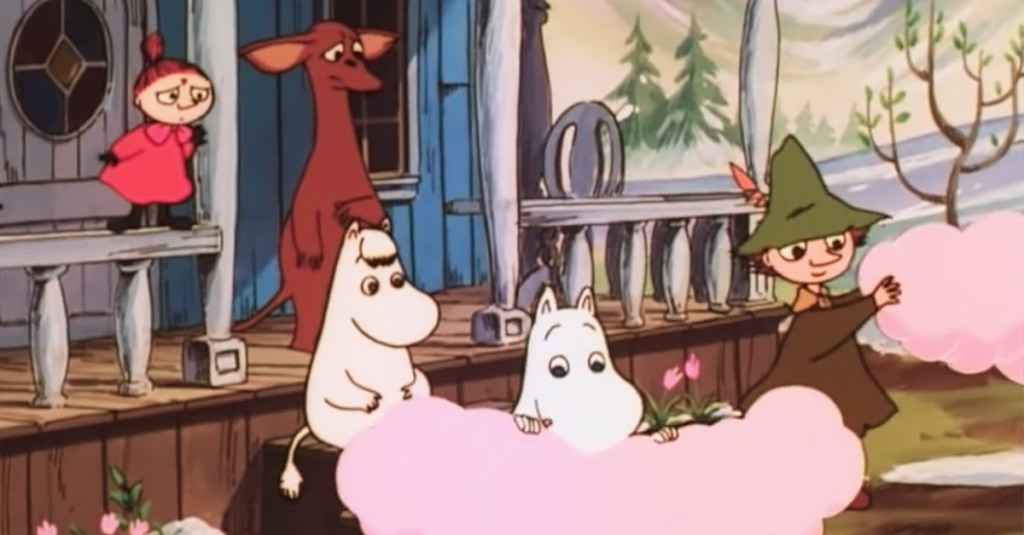
We were delighted by the uniquely charming art and stories of the Moomin family, particularly my friend Carly, who brought the franchise to our attention. Her birthday was the next month, and I was struck by a bolt of creative genius: I should combine our passions and write a homebrew D&D game set in the world of the Moomins so we could play together. It was a simple but potent idea.
THE PROBLEM
As I started, I remember thinking that I would just homebrew a couple of Moomin races or classes so we could make characters and play them in the normal D&D setting. As I began to learn more about the characters and the world, however, it quickly began to balloon. There were so many unique characters that it was impossible to sort them into just a few categories, and the sweet, cozy dressings of Moominvalley were so integral to the feeling the books and shows evoke that it simply needed to be the setting. I would make it so.
This was easier said than done, however, for one specific reason: D&D’s mechanics are not built for cozy.
This conversation I had with my brother this week puts it best:

D&D is not a combat-exclusive game, but it was written and built around a combat-filled world. Monsters of all shapes and sizes exist around nearly every corner, ready to serve as XP bait for a veritable glut of adventurers. It is a world that is not afraid of dealing death or bodily harm, and does not lend itself easily to light-hearted adventures like “gathering berries for jam”. As such, it absolutely should NOT have been the game I chose to base a Moomins adventure around.
Even in 2019, as a complete newbie to the space, I knew that I probably shouldn’t be using D&D as my base. I know this even more now, and having quietly been in the TTRPG space for six-ish years I have many more resources I could use to find or even build an appropriate system for a Moomins game. But it was what it was, so I set out to bend D&D 5e’s mechanics to my whim.
It wasn’t cozy, but dammit, I would MAKE it cozy.
THE CHANGES
Having realized this, I set about absolutely gutting D&D’s combat mechanics.
The first problem I encountered was the pacing of the game: D&D tends to move in cycles of role-playing, puzzle-solving, and combat, rinse and repeat until you’ve spent 3 hours playing without realizing it. Removing a third of this equation upset the balance, so I implemented something I call the “encounters system”. It’s a pretty simple tool, just a way to give the DMs more control over the narrative. Each step of the story, or each problem to be solved, is set as an “encounter”, with a specific success threshold and a series of narrative beats to hit. It’s maybe a tad more railroad-y than many people like in their D&D games, but to someone who cut their role-playing teeth on narrative actual-play podcasts (me, it’s me) the structure provided is useful, even comforting, and it provided a solution to the uneven pacing.
The next problem was that of HP; if characters were not fighting monsters, there would be no bodily harm for them to sustain, and HP would largely be pointless. Not wanting to entirely discount this mechanic, I decided to make the HP system revolve around emotional damage. Arguments, failing in a task, experiencing disappointment, picking fights– all of these are ways that emotional damage is dealt during the game. If a character loses all of their emotional HP, they experience a breakdown (determined by the player and DM through role-playing elements), and are removed from gameplay for 3 encounters. This turned out to be one of the more transformative elements of Moomins and Dragons: by dealing “damage” for disappointments and arguments, the stakes of the cooperative role-play and puzzle-solving elements suddenly became much higher.
I made other, smaller changes too: I entirely stripped armor class and hit dice, and replaced them with simple contests between the DM and the player. Healing can only be done between encounters, and takes the form of encouraging dialogues between players. Above everything, I wanted to encourage teamwork among players, to invoke the strong sense of community I felt in Moomins media.
That is what made all the difference.
MOOMINVALLEY IN NOVEMBER
They say that art is the biggest tattletail of all, and from the fans I’ve chatted to since releasing this game, there is a consensus that this is particularly true for Tove Jansson and the Moomins. As a Swedish-speaking Finn born in 1914, and as a queer woman who dated both men and women during her lifetime, Jansson was no stranger to marginalization, nor indeed to political chaos.
The Moomin family deal with problems as big as war, social upheaval, and natural disasters, but equally important are the more-personal hurts: loneliness, isolation, abuse, and self-acceptance. In a quote I list in the introduction to the game, Jansson says: “I suppose that I wrote mainly for myself; perhaps to regain something of the free, adventurous and secure summers of my childhood. But perhaps I also sometimes wrote for the sort of child who feels pushed aside and timid.”
The results speak for themselves. Moominvalley is chock full of unique characters that do not always get along, but who are all invested in building a community all the same. They depend on each other, fight with each other, and everything in-between, and the Moomin family themselves are an integral part of that community. No one is pushed aside, and those that are timid are given the encouragement and time they need to come out of their shells.
Nowhere is this more evident than in the last of the Moomin books, Moominvalley in November. This is the only book that actually does not feature a single member of the Moomin family. Instead it focuses on their friends, who attempt to visit the family only to find that they’ve left their house for an adventure abroad. They wait weeks for their return, and as the autumn progresses they realize the real impact of the family on the community. They attempt in various ways to fill the hole the Moomins’ absence has left in their lives– in some ways they succeed, pulling together to help each other. But in other ways, they fail: personalities clash, there are fights and arguments and disappointments, and the Moomins’ absence is felt all the more severely.
The result is a somber novel, the most reflective in the series, which only serves to underscore the feeling found in the other novels. Not only is the camaraderie and companionship to be found in the Moomins’ various adventures real, it is finite. Something that, if not appreciated and nurtured, can go away.
THE GENTLE RADICAL
This is the true essence of what I’m calling the “gentle radical”. Jansson’s work, while gentle, did not easily bend to my whims. It stood firm, holding its own shape as I attempted to graft the various game mechanics into it. Some stuck, but some bounced off, leaving the unique mess that is Moomins & Dragons. What stuck was what cozy fantasy, for all its faults, is about: teamwork, friendship, and the care and keeping of your family, friends and community.
There are those in our world, many of whom possess a great deal of political, economic, and/or social power, that would tell us that it’s useless to try to build these things. That they’re nice in theory, but that it will never happen for you. That the world is out to get you, that growing powerful enough to destroy everyone that wronged you is the only way to truly protect yourself. That love and comfort are childish things, and should be put off.
When people in power are the ones peddling this nonsense, it is inherently radical to reject their thinking. It is rebellious to give love unabashedly and present kindness to the world. It is revolutionary to build the infrastructure to support your community members, instead of letting them go without because they can’t do it by themselves.
This is the alchemy of the gentle radical.
CONCLUSION
After all this, I don’t want you to think that I think cozy fantasy is the only way to write speculative fiction. I actually think grimdark and cozy fantasy come from the same place of frustration. Grimdark seeks out the dark parts of our societies and pulls them into the light, exposing them for all their frank injustice, whereas cozy fantasy seeks to illustrate the ways we can improve them, and presents hope for things to get better. Both demonstrate a deep concern for humanity and a desire for things to improve, and both have their places in the great fiction thought experiment.
We need both. We need to explore the darkest underbellies of humanity, then find ways to band together and improve things. We need to mourn, to learn, to improve, to love, to help and be helped– in short, we need to live.
This, in the end, is what writing Moomins & Dragons helped me to do. It was a project made out of love for a friend, and when things imploded in 2020 I decided to take a chance and put it out into the world. It has brought me joy. It has, I hope, brought hundreds of fellow Moomins fans joy. Even if it doesn’t really make sense for it to be a Dungeons & Dragons mod, even if the gameplay is a little wonky and uneven, even though it will never win me awards or prestige: the love is real, and it was worth it.
POSTSCRIPT
I was inspired to write this post after an extremely, extremely kind comment left on the Moomins & Dragons: Ultimate Edition web page by itchio user hotel.kilo. I was so charmed to receive such a comment on M&D so long after its publication, and was impressed by how deeply they seemed to just “get it”. I am so grateful for their kind words, and hope that the explanation I’ve given for my various thought processes here help shed even more light on the way Jansson’s work has shaped my personal philosophies. Thank you all ❤
 R.H. Walker, Author
Leave a reply to literary analysis: dr. mcalister (or, how i learned to stop worrying and love the romance novel) – R.H. Walker, Author Cancel reply