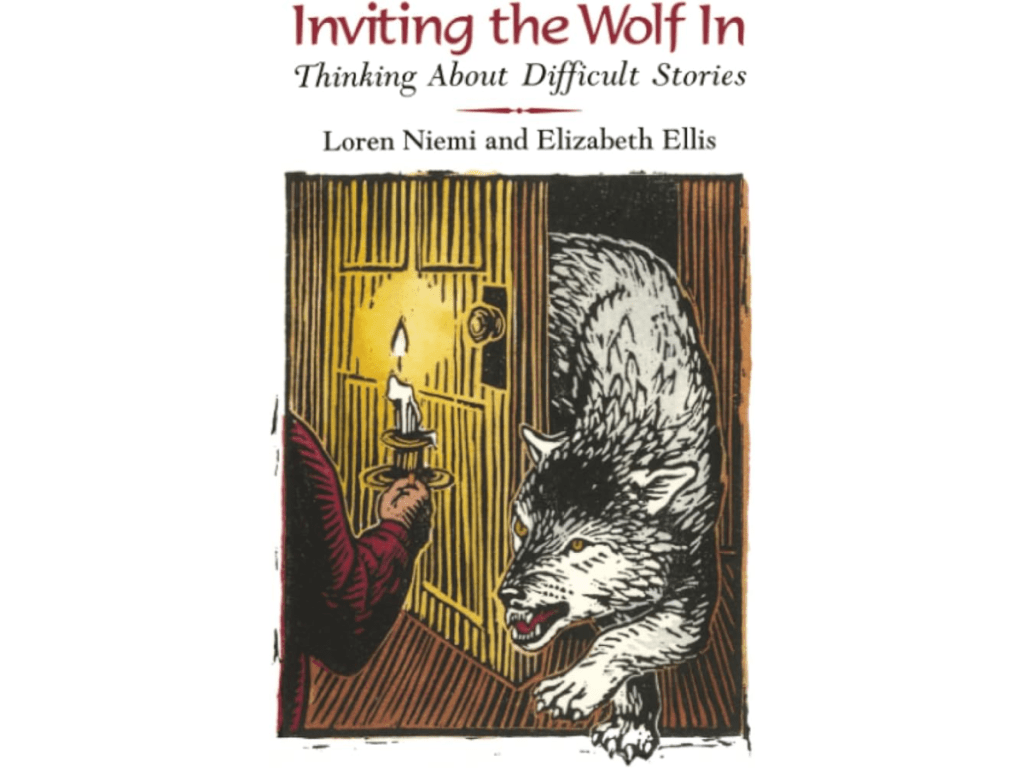
Of the books I’ve read for the By Writers For Writers project so far, this may be the most unique. Niemi and Ellis are storytellers by trade, and their unique perspective on how a story is crafted makes for a valuable reading experience.
The first thing I appreciated about this book is that Niemi and Ellis don’t take it for granted that difficult stories are worth telling. They are considerate of the reasons someone might or might not choose to tell a difficult story, and the book is very empathetic in its overall approach. It does not seek to force the storyteller to tell a story they are not ready to tell, nor to tell a story an audience may not be ready to hear. Despite this, they are firm in their conviction that these kinds of stories can and should be told.
A “difficult” story is defined in the book as any story containing or pertaining to subject matter that either a storyteller or an audience member may find difficult. (This book was first published in 2001, so in more modern vernacular we’d refer to this as any material a person may find “triggering”). I think especially for young creators, the fear of discomfiting people can get in the way of telling the best story they can. This book does well to help allay some of those fears, and leans heavily into the belief that even if a story contains sensitive material, it is still worth telling, and that there are choices that can be made to help mitigate any harm that might be done.
Writers (at least, the writers I’ve met) have a tendency to describe their stories as entities of their own. They consider themselves as conduits for their stories; I myself have often described writing as a paleontology dig, where the story in its purest form already exists, I just have to uncover it. When dealing with difficult subject matter though, Ellis and Niemi are firm in the belief that storytelling is little more than a series of choices. There can be subtlety in telling a potentially triggering story, and the examples provided show just how effective even small changes can be.
At the end of each chapter, an exercise is provided to help writers experiment with the principles provided. I am always appreciative of these kinds of additions in craft books. Another great addition are the example stories sprinkled throughout the book. These were mostly contributed by Niemi and Ellis themselves, but there are some provided by guest writers that are equally great, and I found that many of them affected me more deeply than I expected going in.
Overall, I enjoyed this book very much. The questions posed about who gets to tell a story, when and how they choose to tell that story, and how an audience may react to it, are worth pondering for any kind of writer across any genre.
#
Wow, look at that! Our first milestone! Ten books down for this project, only…. 90…. to go.
Well, I knew going in that this was a lofty project, and there’s still plenty for me to learn. And considering how much I’ve learned already, I can’t wait to see how much more I can improve. Here’s to ten more excellent books on writing!
 R.H. Walker, Author
Leave a comment