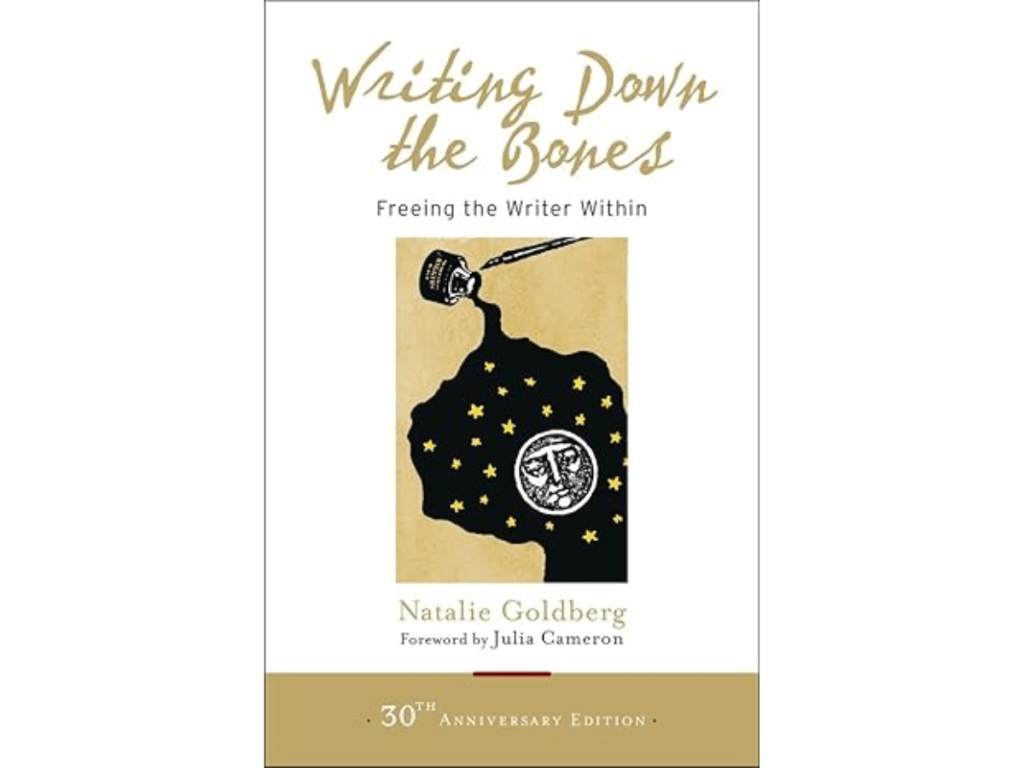
I would classify Writing Down the Bones in the same category as Bird by Bird and Zen in the Art of Writing, more focused on the writer’s persona and personal philosophy than the mechanics of the craft. Goldberg’s approach is particularly unique as it leans heavily into her Buddhist beliefs and spiritual practices. That, more than anything else, is the shaping force of this book, and I appreciated how personal Goldberg’s approach felt.
It’s not just Buddhism that frames Goldberg’s work– it’s her Jewish heritage, her years teaching writing seminars in the Midwest, her love of writing itself. Every place she has lived, every food she has ever loved, every person who has given her advice, all of it shows up here because when it comes to writing, she leaves nothing on the table. This is present in almost every piece of advice she gives too, because it really is the essence of being a writer. You have unique experiences, and as the only person to have experienced them the way you have, you have a responsibility to record it as accurate to your recollection as you can. That, more than anything, is the heart of her message.
Goldberg has other books about writing that I would be interested in exploring, if only because as someone who is already entrenched in the practice of writing, nothing is included here that I didn’t already know. There were many great reminders, to be sure, but the subtitle “Freeing the Writer Within” was fairly literal. It reads more as advice for people who don’t know how to start writing, rather than someone who has already started.
I want to be clear: this is not a bad book. It is a very good book, with lots of good advice. It just wasn’t the right time for me to be reading it. That said, there are individual pieces of advice and essays in this collection that I really loved, and want to highlight:
- “Learning to write is not a linear process. There is no logical A-to-B-to-C way to become a good writer. One neat truth about writing cannot answer it all. There are many truths. To do writing practice means to deal ultimately with your whole life.”
- “First thoughts are unencumbered by ego, by that mechanism in us that tries to be in control tries to prove the world is permanent in solid, enduring and logical . . . If you express something egoless, it is also full of energy because it is expressing the truth of the way things are.”
- “There is no permanent truth you can corner in a poem that will satisfy you forever . . . They are not you. They were a great moment going through you. A moment you were awake enough to write down and capture.”
- “In writing with detail you are turning to face the world. It is a deeply political act, because you are not just staying in the heat of your own emotions. You are offering up some good solid bread for the hungry.”
- “You can’t go deep into your writing and then step out of it, clamp down, go home, “be nice,” and not speak the truth. If you give yourself over to honesty and your practice it will permeate your life.”
So in conclusion, I think I’m going to try and be a tiny bit more picky about the books I select for this project moving forward. This is maybe something I should have anticipated in starting such a big project, (100 books on writing is a lot and is going to take me years), but as I grow as a writer, both through reading these books and through the practice of writing, the things I need to learn are going to change. The selections I make are probably going to become a bit more niche, focus more closely on different genres or parts of the writing process, so I can make sure I’m getting the most out of this project at I can.
 R.H. Walker, Author
Leave a comment