(Cover image by Arno Ryser on Unsplash)
Welcome back to Demo Sundays!
Last week we found the emotional end of our story, the moment when our dear protagonist Elliott finally, finally learns his lesson. This week, we’re importing everything we have so far into our favorite drafting software (like many authors I prefer Scrivener), and preparing ourselves to jump feet-first into our draft.
Let’s get started by creating these folders:
PART 8: THE SIX FOLDERS
- Key Characters
- Story-specific bio
- Backstory scenes they’re involved in
- Rules of the World
- Keeps track of your worldbuilding & internal logic
- Idea List
- Any scene ideas that are not necessarily relevant
- Random Scene Cards
- Scenes you know ARE relevant but you don’t know where they go yet
- Scene Cards in Development
- Arrange in order as you develop the story’s trajectory
- Scenes
- Your novel, in order
I’ve got those made, take a look!
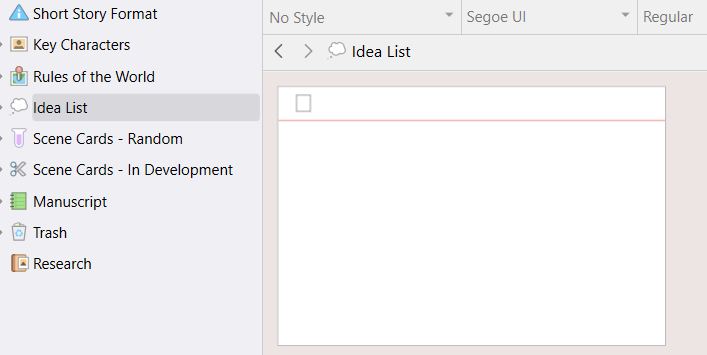
Now let’s move everything from our first five posts to their proper places.
Everything from post #1 goes into the “Rules of the World”, to help me remember the emotion and tone I’m shooting for. Everything in post #2 and post #3 is going into the Key Characters file, specifically in Elliott’s section. Then the scene card from post #4 goes in the “Scene Cards in Development” section, since we know it will be at the beginning. The scene card from post #5 will live in the “Random Scene Cards” for now, as we know it will be relevant later, but we still aren’t sure what all leads up to it.
PART 9: THE MESSY MIDDLE
- Chances are, you have a pretty good handle on the shape of your novel already. Write down the basic strokes of what you have so far (this will be similar to, like, the inside dust jacket description of the novel)
- Elliott’s friends once told him he’d never write a book. He’s beginning to fear they’re right; he’s been in Pelican Town for years and has nothing to show for it. But everything he knows about himself is turned upside down when Harvey, the town doctor accuses Elliott of kidnapping his own children. Elliott didn’t kidnap his children– he’s fairly certain he doesn’t have any. But Harvey has proof, a disturbing amount of it, and as they begin to look into the matter it becomes clear that there is much Elliott doesn’t remember. How, or why, did he forget?
- Make a list of all the points your character is forced to take action, and start scene cards for everything that’s specific
- Elliott must take action to defend himself against Harvey’s accusations
- Elliott must infiltrate the Farm to discover what the Farmer knows (alone? With Harvey and/or Leah?)
- Elliott must make the choice to flee the valley.
- Elliott must make the choice to come back despite his fears.
- Elliott must find a way to defeat the Farmer (this will involve finding the source of her magic; this will also help him break the curse on his children that keeps them as doves).
- Now, make a list of secrets your protagonist has, and what lies she’s told, both to others and herself. What scene ideas come from there?
- WE know that Elliott is struggling with his self-image in the beginning, but he’s going to try his hardest to keep that from the other bachelor/ettes. He can’t sacrifice his suave public image!
- I don’t think Elliott has a ton of secrets other than this, frankly. This is a story built largely around his ignorance of a situation. It’s possible that he’ll pick up additional secrets as the story goes on, but for now I don’t have much for him.
- What external obstacles did you plant in the past that will resurface for your protagonist now? What scene ideas come from there?
- Obviously the Farmer and the collaborating townsfolk are going to be our biggest obstacles.
#
These next few parts are largely advice for drafting, and questions I will need to answer for most every scene that we come up with. I’m not going to answer them right now (with some exceptions, there are some bigger-picture things left to do still), but I’m posting them so you can see what I’ll be thinking about as I begin the draft.
PART 10: THE WHYS
As you start unraveling your plot, each scene or plot point must pass muster with the three “whys”:
- Why does my plot need it to happen?
- Why CAN it happen (read: is it even possible?)
- Why WOULD it happen, given protag’s inner struggle?
PART 11: IT’S ABOUT TIME
What time frame do you expect this story to be set in? How big is your stage? Frame the story based off of these timelines.
- We know this is going to be a short story already, I’m shooting for somewhere between 4,500 and 5,000 words.
- I think in order to stay in this scope, the story either needs to be one night; if I try to spread the scenes over a week I’m positive it will get away from me.
PART 12: SUBPLOTS & SIDE-CHARACTERS
Subplots tend to spring from:
A) External events that happened pre-book
B) Secondary characters
- Make a list of potential subplots that are already in play when the novel begins.
- Harvey is here already, of course. He brings the initial accusation to Elliott, and in my mind he is another ex-spouse who has been memory-wiped, so the discoveries have big impacts for him too
- Make a list of your secondary characters, and ask yourself: what might this character open my protagonist’s eyes to? Create a bio for this character and see what leaps out at you as a potential scene.
- There is a lot of story potential for Leah and Willy too, but given how short we’re aiming for I’m trying to limit the number of active characters we have, lest this balloon.
- I have ideas for both the bach and non-bach groups of Stardew villagers, but to keep it simple (and short) I think I’ll treat those respective groups as a single character, instead of individual groups.
- Do the same for pre-story characters (parents, siblings, perhaps good or bad teachers come to mind). Flesh out their shared history with the protagonist
- We could do this for Elliott’s friends in Zuzu City, but again, we have so little space, I don’t think we’ll have room to explore any of these characters.
- Now that you have a full collection of character bios, make a list of potential scenes and either add them to your idea list or start scene cards for them.
- Done (I’ll share these in a future post!)
PART 13: LET THE WRITING BEGIN
You should have a good enough idea of your story trajectory to write scenes 2-5, as well as going back to edit the first scene.
You also have a rough trajectory of scenes to work from going forward.
Change is constant. Don’t let it throw you. This is a part of the process.
PART 14: MAKE THE INVISIBLE, VISIBLE
Your protagonist must draw a strategic conclusion from everything they notice
You must get emotion onto every page
You must stay in your protagonist’s subjective mindset
PART 15: LAST WORDS
Ask “Why?” of everything
Ask “And so?” of everything
#
And there we have it! We’re ready to get started on our draft!
I’m not sure what comes next, honestly, now that we’ve gotten through the notes I took while reading. I think perhaps I’ll try to finalize the outline and scene cards and share those next week. I am drafting another short story right now, though, so I’m not sure how much I’ll actually have to share. I’ll have to play it by ear!
Thanks so much for all your support so far! I hope that this project has been interesting to you, and I hope that you’re excited to see the final project!
 R.H. Walker, Author
Leave a comment