
(Cover image by Davey Heuser on Unsplash)
Welcome back to Demo Sundays!
Last week we expanded a little bit into Elliott’s backstory, seeing what his life was like both before and after he married the Farmer. This week, we’ll explore several ideas for the beginning of our story. How does Elliott start out on this journey? Where does it most make sense for the reader to join him?
Let’s get started!
PART 6: FINDING THE BEGINNING
Question 1: Extract as many ideas for your novel’s main problem as you can
Cron defines this “main problem” as the “unavoidable external change that will catapult [the] protagonist into the fray”. In the Hero’s Journey you could consider this either the Call to Adventure itself, or the Crossing of the First Threshold. Save the Cat calls this the Catalyst. Whatever you want to call it, it will serve to kickstart the protagonist’s journey, both externally and internally.
Let’s think of some potential problems for Elliott:
- Whatever we do, Elliott’s past life with the Farmer is going to play into it. Perhaps Elliott’s publisher starts hounding him about his manuscript, and Elliott, having entirely forgotten about his previous career and convinced that he’s never written a book in his life, starts to panic. He needs to finish something, anything, quickly.
- Perhaps Willy, Elliott’s friend and landlord, feels some level of regret with his own involvement of what the Farmer is choosing to do. In a veiled attempt to either reveal the truth or get Elliott to safety, he could give Elliott an impossible task at the risk of losing his home (which Willy is renting to him).
- Perhaps one of the other bachelors has figured out the Farmer’s game already (I’m thinking Harvey, he’s one of my other favorite romances and he’s a doctor, so he could have access to some private information that helps him piece it together). Since Elliott is only the latest victim of the Farmer’s conquests, they could start leaving clues for Elliott to follow. (We’ve established Elliott is impulsive by nature and reads books to experience a sense of adventure, perhaps he feels the compulsion to solve the mystery and live his own detective story? There could also be a blackmail element, insurance in case Elliott decides not to follow through.)
- In this case, what would the blackmail be? Elliott doesn’t have any deep dark secrets.
- It could be a threat towards his friends, either in Zuzu City or in Pelican Town? Or perhaps a threat to tell his friends from Zuzu City (the ones that mocked him so roundly in our worldview scene), that
- Children could be interesting element here. One of the things the Farmer can do in resetting their romantic life in-game is to turn their children into doves. Perhaps Elliott’s now-dove children find him and start hounding him, trying to point him in the direction of the truth about the Farmer, and Elliott has to comply or else risk never getting another night of sleep.
- We could combine the last two options? Perhaps one of the other bachelors overhears two of the other townspeople talking about the farmer’s and Elliott’s children, realizes they haven’t seen them in a while, and thinks that Elliott had something to do with their disappearance. Elliott, determined to prove his innocence (he hasn’t even MET this new farmer, how could he have KIDS with them), works with this other bachelor to prove that he’s innocent, and together they uncover the sinister plot. (I like this one…. this might be the one with legs).
Question 2: Choose one of these problems to be the connector between the plot and the emotional third rail, using the following qualifiers:
- Can the problem build?
- Is there a real world, specific, impending consequence that this escalating problem will give my protagonist no choice but to face?
- Is there a clear cut deadline, a ticking clock counting down to that consequence?
I have a feeling that that last problem we came up with is going to be our winner, so let’s give it a go: Harvey comes to Elliott with evidence of his children’s existence, and demands to know what he did with them. Elliott professes his innocence, and starts working with Harvey to uncover the truth.
- Does it build? Yes, there are several potential points for escalation. If anyone else becomes suspicious of the missing children, they are also certain to come after Elliott. If the Farmer catches wind of anyone else sniffing around, they will up their manipulation game, potentially putting our heroes at even further risk. Asking about the children to any of the non-bachelor townsfolk will immediately alert all of them that the bachelors are starting to grow suspicious, and in a bid to protect themselves they will also start working against the bachelors.
- Is there a specific consequence that this problem will force my protagonist to face? Yes. Aside from all the psychological horror stuff that Elliott is about to be subjected to, he’s literally being accused of murder. He fears that if he doesn’t clear up this misconception, he’s going to be falsely imprisoned.
- We can easily make Harvey give Elliott a deadline or an ultimatum. If Elliott can’t prove that he’s innocent by, say, the Feast of the Winter Star, Harvey will turn him into law enforcement. (This might be a bluff… I’m pretty sure Stardew doesn’t have law enforcement. Maybe Zuzu City has jurisdiction? Or perhaps Harvey threatens to expose him to the town at large, implying that they’ll enact a kind of vigilante justice? To be fair I would also be scared of that.)
Question 3: Be ruthless. Don’t let any problem pass the gate unless it meets all three criteria with gusto.
Done! What’s next?
Question 4: Is your problem capable of forcing your protagonist to make the inner change that the story is actually about? Will the problem’s impending consequence force my protagonist to struggle with her misbelief?
More than I thought it would! Forcing Elliott to prove his innocence also forces him to directly confront his low self esteem. He’s made to stand up for himself for potentially the first time. It also confronts the other problems we identified with him: Elliott can’t afford to be impulsive when his every move is being watched, which forces him to think ahead, and reading to escape his problems will only waste his precious time.
Question 6: Regardless of if the protagonist succeeds, will the approaching consequence cost a huge emotional toll?
Yes, I think it will. Being considered a suspect in a crime would be taxing on anybody, especially a crime of such a serious nature, and especially when Elliott really knows nothing about it. No matter how he acts in this situation, Elliott is in for one hell of a time.
Question 7: Sketch out the “ticks” leading up to your opening scene. Find the tick that catapults the protagonist into unavoidable action, the one that pulls you forward.
Let’s start with a list of events as we know them so far and work our way from there:
- Elliott quits his job and comes to Stardew Valley to attempt to write his book.
- He makes several failed attempts at coming up with a compelling story
- He makes friends in the valley, and begins to enjoy his time there separate from his work.
- He likes his time in the valley so much to the point of neglecting his work.
- Elliott meets the Farmer, and is struck with inspiration.
- As his affection for the Farmer grows, so does that inspiration.
- He finishes the first draft of the book, and completes a reading at the public library (this is lifted directly from Elliott’s “heart events” in-game).
- Elliott and the Farmer begin dating, and his book is successfully published.
- They marry.
- Elliott goes on a tour to publicize his book (this is also lifted directly from the game).
- After he returns home, his children (Cordelia and Aramis) are born, and Elliott finds that he has a new goal in life: being a good dad.
- For some reason (a reason we haven’t defined yet, but also a reason that might not matter?), the Farmer chooses to end their marriage.
- Elliott is unable to take custody of his children in the divorce (probably due to the fact that he lives in a literal shack on the beach).
- Soon after they file the divorce papers, the Farmer makes an offering to the two dark shrines, erasing Elliott’s memory up to the point of their first meeting and turning the children into doves.
- Elliott goes about his life, newly oblivious, and is a little annoyed at these doves that keep following him around.
- The other bachelors and bachelorettes notice that the children aren’t hanging around anymore, but the Farmer makes excuses for them, and they don’t want to bother Elliott as they assume he’s still broken up over the divorce.
- However, after they miss their annual check-ups, the Farmer lies to Harvey, telling him that Elliott took the children against the custody arrangement and isn’t telling her where they are. She pretends to be afraid for them, warns Harvey that Elliott is dangerous and should not be confronted, that she’s handling it.
- Harvey obviously ignores the warning and begins monitoring Elliott, looking for any hints as to where the children might be.
- After learning nothing (obviously, because Elliott doesn’t have the kids), Harvey is caught lurking. Instead of making excuses, Harvey decides to be honest and accuse Elliott of kidnapping his children.
- He issues an ultimatum: Elliott must produce his children by the end of the week, or Harvey will report him to the police (remember that thing I said about the police possibly just not existing earlier, that will become important later lol).
- We have now hit the tipping point. If Elliott does not work with Harvey to prove his innocence, he will likely be imprisoned. Even if he isn’t imprisoned he will likely be ostracized in the community after the dust settles (small towns just be like that sometimes).
Question 8: Answer these questions, and fill out a “scene card”.
Excellent, now we get to dive into scene cards!
#
SCENE CARDS
A scene card is exactly what it sounds like: a one-page summary of a scene. Cron’s have some really key points that will be useful to use here.
For reference, this is what a scene card will look like (I found and printed this template from Google Images, the original website is defunct but it seems like this particular one came from Ashly Hilst. Thanks, Ashly!)
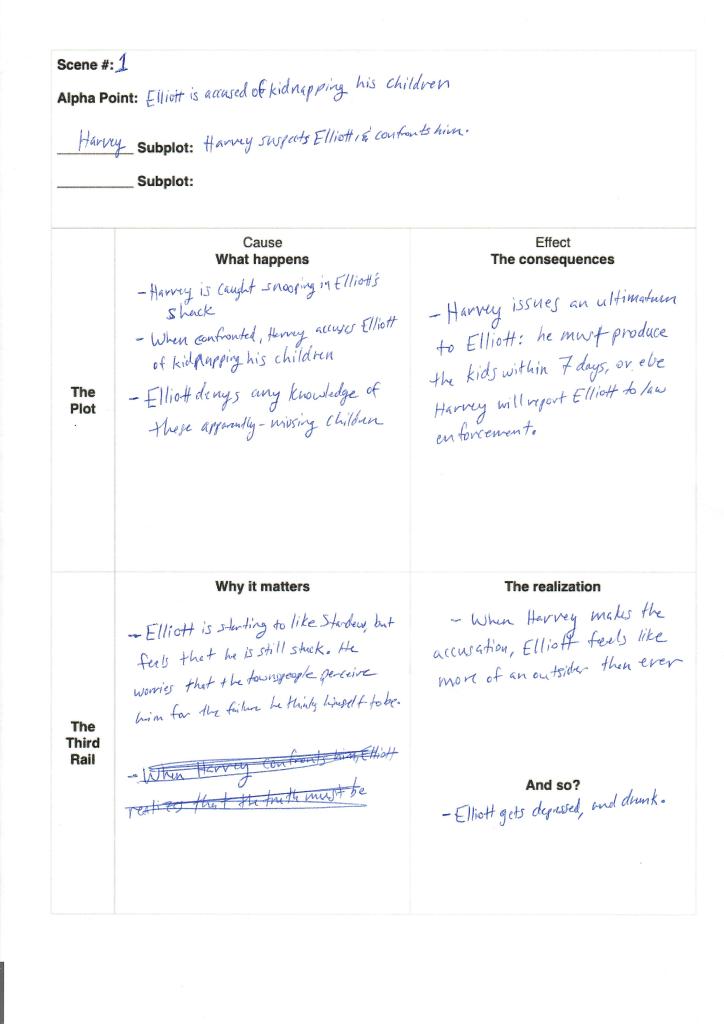
Please don’t worry about trying to read my handwriting, here’s a transcript:
#
Scene #: 1
Alpha Point: Elliott is accused of kidnapping his children
Harvey Subplot: Harvey suspects Elliott and confronts him.
The Plot:
- Cause (What happens)
- Harvey is caught snooping in Elliott’s shack
- When confronted, Harvey accuses Elliott of kidnapping his children
- Elliott denies any knowledge of these apparently-missing children
- Effect (The consequences
- Harvey issues an ultimatum to Elliott: he must produce the kids within 7 days, or else Harvey will report Elliott to law enforcement.
The Third Rail:
- Why it matters
- Elliott is starting to like Stardew, but feels that he is still stuck. He worries that the townspeople perceive him for the failure he thinks himself to be.
- The realization
- When Harvey makes the accusation, Elliott feels like more of an outsider (and a failure) than ever before
- Elliott gets depressed, and drunk.
#
It looks so simple but is also so complex, giving space to both plot and character arcs. If you’re interested in this method so far I would definitely recommend reading the book, because Cron gives a more thorough explanation than I ever could.
I really like that the cards provides space to consider what’s happening to the side characters in any given scene, and that they encourage the author to consider cause and effect in deciding what happens next. It’s an intricate top-down view, and the points it hits are exactly what I’m looking for before I start writing a scene. I think this is going to be a great exercise to keep in my back pocket.
#
That’s it for this week! Come back next week as we puzzle out the end point of our story, and generate more scene cards to use in the weeks to come.
 R.H. Walker, Author
Leave a comment